

The science of tennis and padel ball pressure
A new tennis ball typically holds about 12–13 psi more pressure than the air around it, and a new padel ball a little less, about 10–12 psi. Much of the bounce comes from that pressure. Dropped from 254 cm onto a hard surface, a medium-speed tennis ball must bounce 135–147 cm under ITF rules, and a padel ball 135–145 cm under FIP rules. Here is what the numbers mean, why the pressure disappears, and how a tennis ball pressurizer or padel ball pressurizer brings it back.
Tennis and padel ball pressure in PSI
New tennis ballabout 12–13 psi
New padel ballabout 10–12 psi
Pressurebox, normal mode20–22 psi
Pressurebox, high-pressure mode26–28 psi
Pressure above the surrounding air (gauge pressure). To restore a ball, a pressurizer has to hold more pressure than the ball itself.
| Above the surrounding air (gauge) | Absolute | |
|---|---|---|
| The air around us, at sea level | 0 psi | 14.7 psi |
| New tennis ball | about 12–13 psi | about 27–28 psi |
| New padel ball | about 10–12 psi | about 25–27 psi |
| Pressurebox, normal mode | 20–22 psi | 35–37 psi |
| Pressurebox, high-pressure mode | 26–28 psi | 41–43 psi |
Two scales, one pressure. Gauge pressure is measured from the surrounding air. Absolute pressure includes the surrounding air, which is 14.7 psi at sea level. So absolute = gauge + 14.7. A product that states 29 psi on the absolute scale holds about 14 psi above the surrounding air. When you compare pressurizers, check which scale each figure uses. All Pressurebox figures are gauge.
Tennis: about 12 psi according to the University of Illinois physics department, and about 13 psi for a premium ball according to a Wilson patent. The International Tennis Federation gives a wider range for pressurized balls: “typically at 10-13 psi above atmospheric pressure, or 70-90 kpa”. Padel: the International Padel Federation rule is “an internal pressure between 4.6 kg and 5.2 kg per 2.54 square cm”. Read as kilograms per square inch (2.54 cm × 2.54 cm), that is about 10–11.5 psi above the surrounding air, a little lower than a tennis ball. Pressurebox: user guide.
Why balls lose their bounce
Rubber is not completely gas-tight. Whenever the pressure inside a ball is higher than the pressure outside it, gas slowly passes through the rubber until the two are equal. That is why new balls come in a pressurized can: with similar pressure around the balls as inside them, almost nothing leaks.
Open the can and the process starts. It happens on court and it happens in your bag, whether you play or not. The ball looks the same, but it bounces lower.
Pressure is not the whole story. Felt wears down and rubber ages, and neither can be reversed. But a ball with good felt and low pressure still has life left in it.
How a pressurizer brings the pressure back
The same physics works in reverse. Put a ball in a sealed container where the pressure is higher than inside the ball, and gas passes through the rubber the other way: into the ball. Engineering research at the University of Bath found that storing balls in a pressurized container can slow down pressure loss and even reverse it.
It is gradual too. Balls that have been played once need about 24–48 hours, and balls that have lost more need longer. Stored under pressure between sessions, they also stop losing pressure in the first place.
To push gas back in, the container has to hold more pressure than the ball. Pressurebox holds about 20–22 psi (35–37 psi absolute) in normal mode and about 26–28 psi (41–43 psi absolute) in high-pressure mode, compared with about 10–13 psi in a new ball. Normal mode maintains and gradually restores bounce. High-pressure mode is for quicker restoration or faster balls.
More detail: How does an automatic ball pressurizer work?
Our unscientific test: can you really repressurize a ball?
This page is full of theory, but most players just want a simple answer: can you actually pump up, repressurize or pressurize a tennis or padel ball so it bounces like new again?
Yes. And to prove the point, we went one step further. Store a ball under high enough pressure for long enough, and it can end up bouncing higher than a brand-new ball.
So we took a ball that had been played in five sessions. You can see it on the ball: the logo is almost gone and the felt is slightly torn. After its last session it spent one month in a Pressurebox. Then we dropped it next to a ball straight out of a new can.
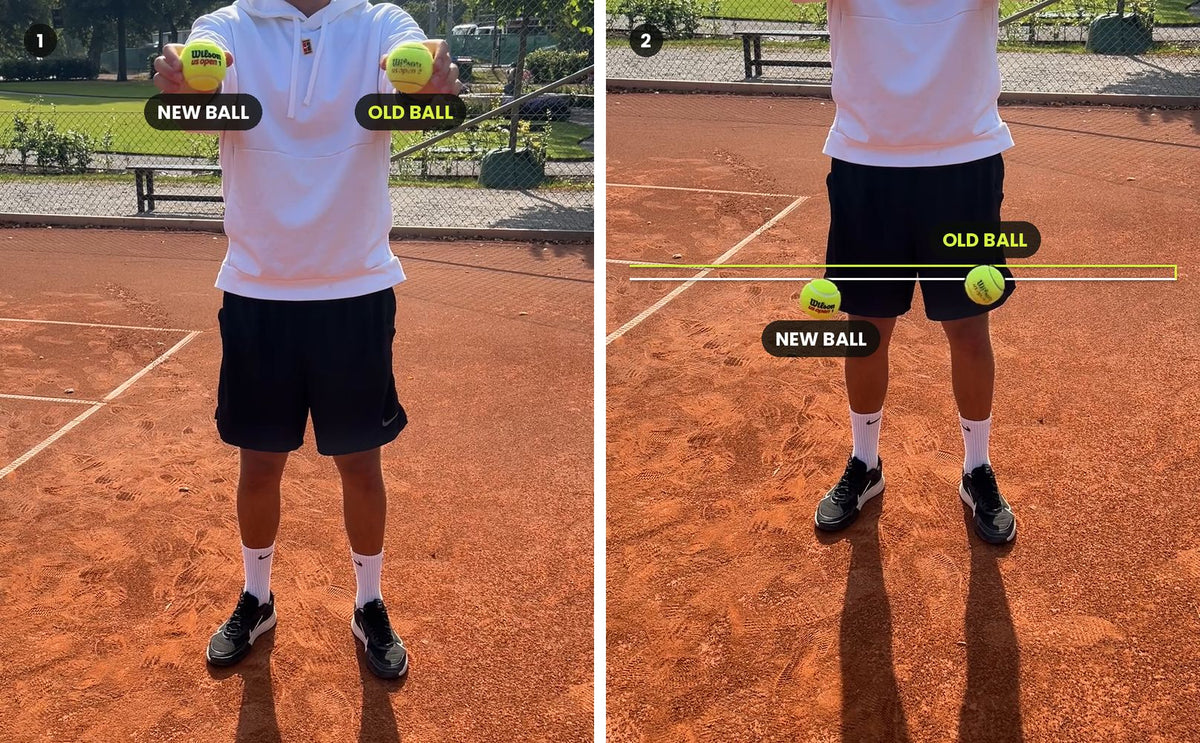
The used ball bounced higher than the new one. It was actually a little over-pressurized, so it no longer had the feel of a new ball. Watch the test on video.
Manual or automatic
A container only works while it holds its pressure. With a manual tube you pump by hand, and pump again when the pressure has dropped.
An automatic pressurizer measures the pressure and tops it up by itself. In Pressurebox Pro Tennis and Pro Padel, a sensor and a small compressor sit in the lid. Switched on, it builds pressure in about a minute and then keeps watch silently until your next game.
Three controls on the lid
The power switch turns it on. The button next to the four lights shows the battery level and changes between normal and high-pressure mode. The deflate button lets the pressure out before you open the lid.
What a pressurizer cannot do
- It cannot repair worn felt or cracked rubber.
- So-called pressureless training balls cannot be repressurized. They get their bounce from a thicker rubber core, not from internal pressure, and they never play quite like pressurized competition balls.
- Balls have to be dry before they go in.
How long do tennis and padel balls last?
Two clocks are running. The pressure clock starts when the can is opened and runs whether you play or not. The wear clock only runs while you play.
For recreational players the pressure clock often runs out first: the balls go soft in the bag while the felt is still fine. For frequent players on abrasive courts, the felt can go first.
Kept under pressure between sessions, the pressure clock stops, and the balls can last until the felt wears out.
More on ball types and lifespan: The ultimate guide to tennis balls.
Short answers
About 12–13 psi above atmospheric pressure, or about 27–28 psi on the absolute scale. The International Tennis Federation gives a wider range for pressurized balls: 10–13 psi (70–90 kPa).
About 10–12 psi above atmospheric pressure, a little lower than a tennis ball. The International Padel Federation rule is 4.6–5.2 kg per 2.54 square cm. Read as kilograms per square inch, that is about 10–11.5 psi.
Gauge pressure is measured from the surrounding air. Absolute pressure includes it. At sea level the air is 14.7 psi, so absolute = gauge + 14.7. All Pressurebox figures are gauge.
Yes. Once the can is open, gas slowly passes out through the rubber, on court and in your bag, whether you play or not.
Yes, for the part of a ball's life that is about pressure. Gas moves through rubber toward the lower pressure. A container that holds more pressure than the ball reverses the direction, so the ball regains pressure and bounce. It does not repair worn felt.
About 24–48 hours for balls that have been played once. Balls that have lost more pressure need longer.
Pressurized balls that still have some pressure and intact rubber. A pressurizer brings back the pressure, not the felt, so balls play best while the felt is in good shape.
To keep the pressure in. With similar pressure inside the can and inside the balls, the gas stays in the ball until the can is opened.
No. Pressureless training balls cannot be repressurized. They get their bounce from a thicker rubber core, not from internal pressure.
Keep the bounce in your balls
Pressurebox Pro holds the pressure automatically between sessions. Pro Padel for 3 balls, Pro Tennis for 4.


About this page
Written by the Pressurebox team in Sweden. We design automatic ball pressurizers and have sold about 20,000 units since 2022. Figures for Pressurebox come from our user guides.
Sources
International Tennis Federation, Balls (equipment guide).
International Padel Federation, Rules of the game: the ball.
International Tennis Federation, Technical booklet 2023 (Rules of Tennis, Appendix I: ball rebound).
University of Illinois, Department of Physics: Tennis ball facts.
Wilson Sporting Goods, patent US 11,951,360 B2: Tennis ball.
R. Cross, University of Sydney: Dynamic properties of tennis balls, Sports Engineering, 1999.
University of Bath: Invention breathes new life into tennis balls, 2005. Published as A. C. Cubitt and A. N. Bramley, Degradation of tennis balls and their recovery, The Engineering of Sport 6, Springer, 2006.
Pressurebox user guides: Pro Padel and Pro Tennis.